Acquisitions
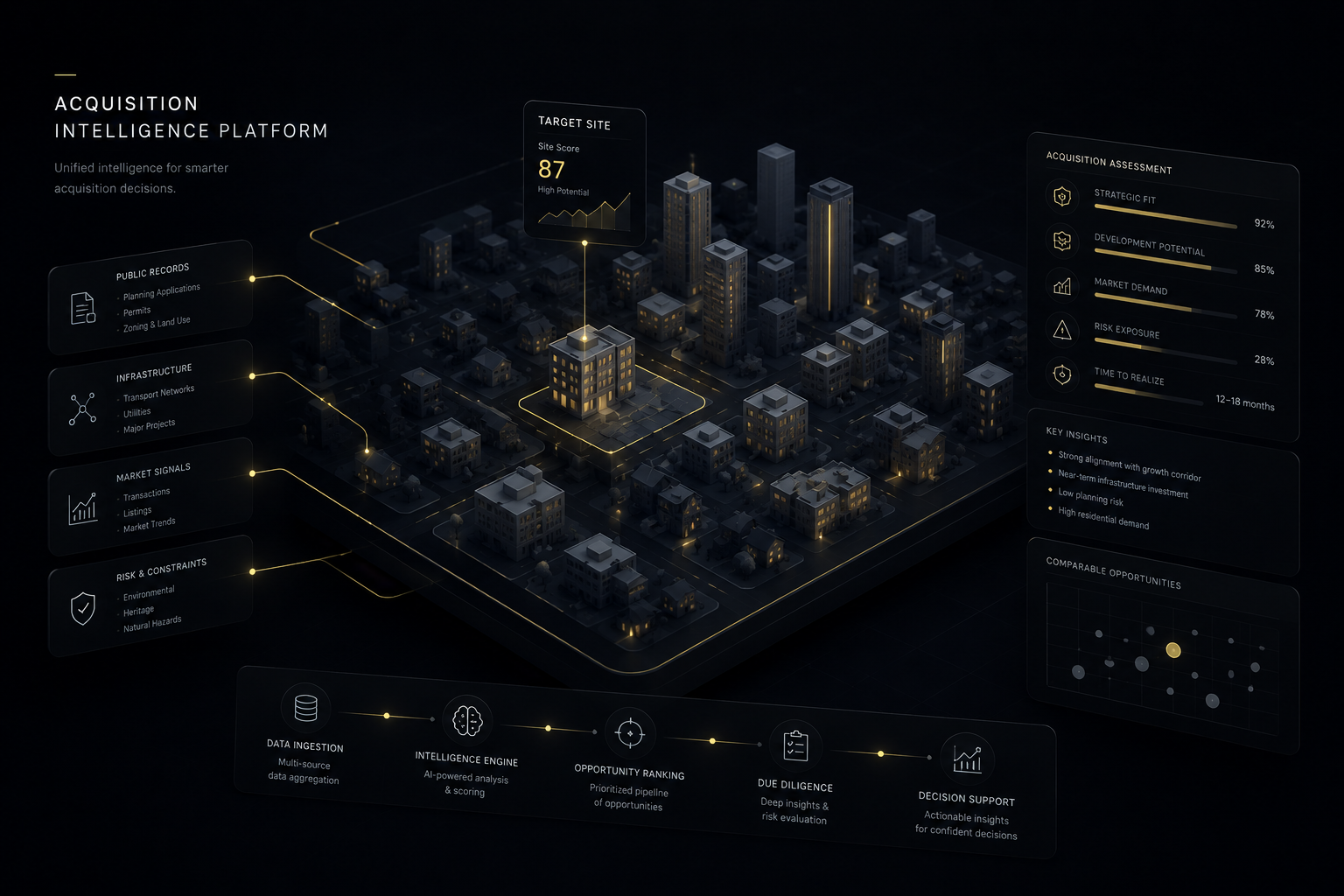
Acquisition Intelligence Platform.
AI-assisted site intelligence for earlier, faster, and more evidence-based acquisition decisions
01
Overview
Acquisition teams often make early decisions with incomplete information.
Detailed feasibility work can be expensive and time-consuming, which means it usually happens later in the process. By then, teams may have already invested significant time into an opportunity before discovering planning constraints, infrastructure issues, market risks, or other factors that materially affect the attractiveness of a site.
This project focused on moving intelligence earlier in the acquisition workflow.
The result was an AI-powered Acquisition Intelligence Platform integrated into an internal product used by acquisition teams to explore potential sites.
02
The operational challenge
Acquisition decisions require many different types of information.
The problem is not that this information does not exist.
The problem is that it is scattered across many public and internal sources, varies in quality, and takes time to review properly.
Traditional feasibility work can identify these issues, but often too late in the opportunity lifecycle. Manual research can also miss important signals, especially when analysts have to review large numbers of sources under time pressure.
Planning applications.
Zoning and land use.
Infrastructure projects.
Transport access.
Demographics.
Market activity.
Comparable developments.
Environmental considerations.
Local constraints.
News and public signals.
Opportunity-specific risks.
03
Before
Before the platform, early-stage acquisition assessment involved a lot of manual research and judgment.
Important feasibility risks were sometimes discovered late.
Analysts had to search across many fragmented public sources.
Research depth varied depending on time, experience, and source availability.
Large numbers of sources made it difficult to separate signal from noise.
Opportunity-specific relevance was hard to judge consistently.
Teams needed faster ways to compare and prioritize potential sites.
04
The AI opportunity
The opportunity was not simply to “search the web with AI.”
The real opportunity was to create a structured acquisition intelligence workflow.
A generic research agent would not be enough.
The system needed to understand the purpose of the site investigation. For example, if the opportunity involved a specific development use case, the system needed to prioritize information that could materially affect that use case and ignore irrelevant noise.
Search deeply across relevant public information.
Assess source trustworthiness.
Filter irrelevant material.
Evaluate information against a specific acquisition purpose.
Apply different evaluation blueprints for different opportunity types.
Produce a source-grounded report that acquisition teams could trust.
05
The solution
I helped build an AI-powered site intelligence workflow that sits inside the acquisition team’s internal product.
The platform supports users exploring potential acquisition opportunities by generating structured intelligence reports from public and internal signals.
The goal was not to replace acquisition judgment.
The goal was to give teams a faster, more consistent evidence base earlier in the decision process.
Gather information from a wide range of sources.
Assess whether a source is trustworthy.
Determine whether the source is relevant to the specific opportunity.
Filter large numbers of sources down to meaningful evidence.
Apply purpose-specific evaluation blueprints.
Generate reports in both PDF and HTML formats.
Provide citations and links to original sources for each factual claim.
06
How the system works
Define the opportunity
The user provides the site or opportunity context, including what the team is trying to assess.
Search and collect evidence
The system gathers relevant information from public and internal sources.
Evaluate source quality
Sources are assessed for trustworthiness, relevance, and usefulness.
Apply opportunity blueprints
The agent uses structured evaluation blueprints depending on the type of opportunity being assessed.
Filter noise
The system may identify hundreds of sources, but only a subset are relevant enough to support the final report.
Generate evidence-linked outputs
The platform produces a report with source-backed facts, key findings, risks, and decision-support insights.
07
Trust and governance considerations
Trust was central to this system.
In acquisition workflows, an unsupported AI claim is not useful. Teams need to know where a fact came from and whether they should rely on it.
The platform was therefore designed around evidence and traceability.
Source-level citation for factual claims.
Relevance assessment based on the opportunity context.
Source trustworthiness evaluation.
Filtering of low-quality or irrelevant information.
Structured blueprints to make agent reasoning more consistent.
Report formats that let users inspect and verify original sources.
The system was designed to reduce hallucination risk by grounding outputs in source material.
08
Impact
The platform moved acquisition intelligence earlier in the workflow.
Faster early-stage feasibility assessment.
Better visibility of risks before deeper investment of time and cost.
More consistent research quality across opportunities.
Reduced manual effort in collecting and reviewing public information.
Improved ability to compare potential sites using structured criteria.
Better decision confidence through cited, source-grounded reporting.
Reduced risk of missing relevant public signals.
The value was not simply faster research. The value was giving acquisition teams a more reliable intelligence layer before committing to expensive downstream investigation.
09
What this project demonstrates
This project demonstrates how AI can support high-value expert workflows when it is designed around domain-specific reasoning, source trust, and decision context.
The system did not ask AI to make acquisition decisions.
It helped teams see more, earlier, with stronger evidence.
Next Case Study