Knowledge Systems
Enterprise Knowledge Assistant.
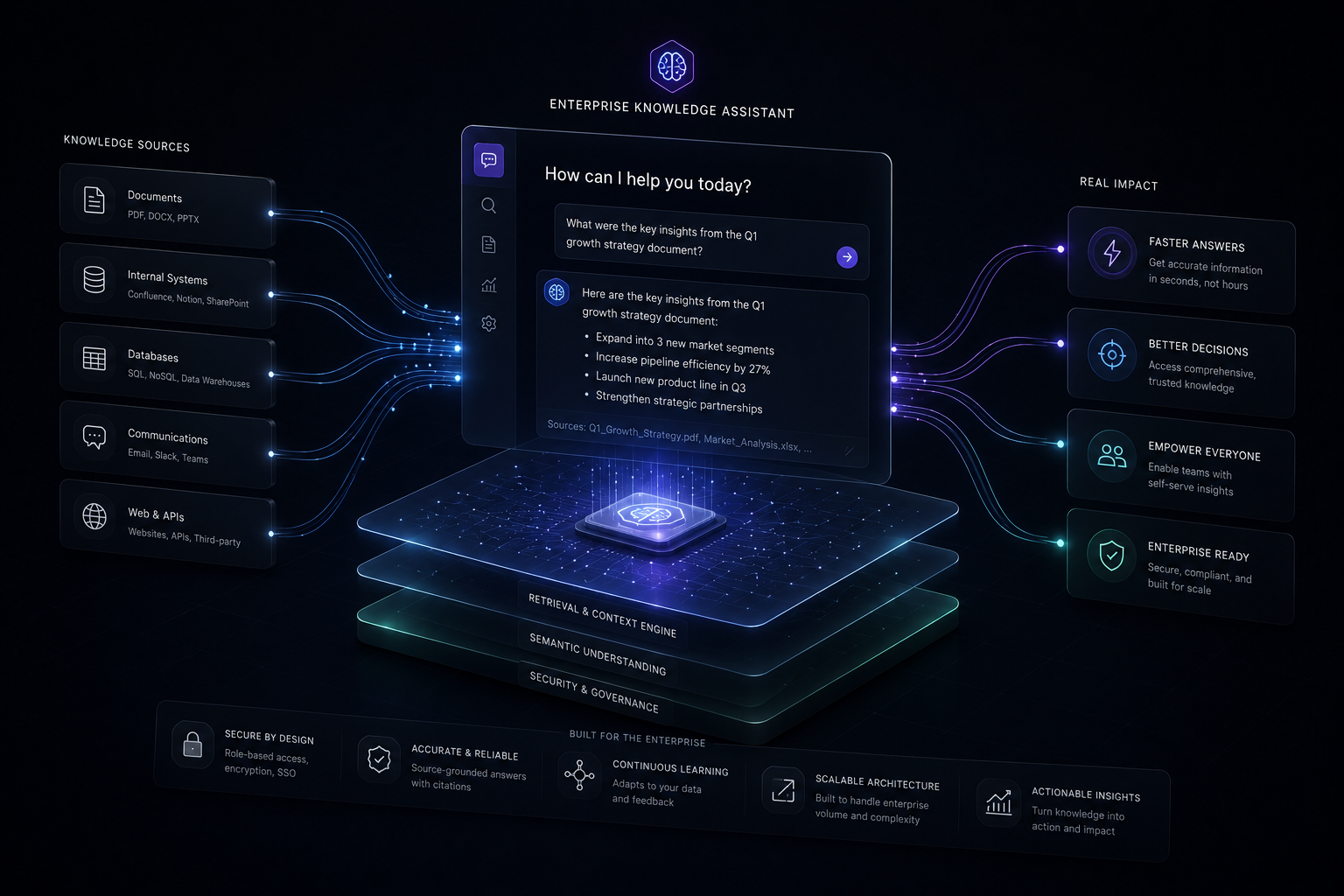
A governed decision-navigation layer for complex operational data
01
Overview
Many organizations already have the data required to answer important business questions.
The problem is that the data is hidden behind complex dashboards, fragmented reports, access rules, and domain-specific logic.
In this case, a business unit had extensive operational data covering inventory, enquiries, leads, opportunities, cancellations, sales, sales staff, discounts, forecasts, and project-level performance.
The information existed, but answering simple executive questions could still be difficult.
The result was an Enterprise Knowledge Assistant: a governed AI agent that allows users to ask operational questions in natural language and receive reliable, access-aware, data-backed answers.
02
The operational challenge
The business unit already had a large Power BI dashboard with many pages of operational reporting.
But the dashboard had become difficult for executives and business users to navigate quickly.
The answers existed somewhere in the data, but users had to know which dashboard page to use, which filters to apply, and how to interpret the result.
Inventory.
Enquiries.
Leads.
Opportunities.
Cancellations.
Sales.
Sales staff performance.
Discounts.
Forecasts.
Project-level performance.
Regional and temporal breakdowns.
Are we tracking well against forecast this quarter?
Which projects are behind forecast?
Which enquiry channels are converting best this month?
How are sales performing by project, area, or state?
Where are cancellations increasing?
Which discounts are affecting performance?
03
Before
Before the assistant, users had to navigate a large reporting environment manually.
Important answers were buried across many dashboard pages.
Executives had to remember where different metrics lived.
Questions involving time, project, area, state, or forecast comparisons required careful filtering.
Business users depended on analysts for recurring questions.
Data access rules needed to be preserved.
Open-ended AI access to data was too risky for high-trust reporting.
04
The AI opportunity
The opportunity was not to build a generic “chat with your data” tool.
That framing is too weak for enterprise reporting.
The real opportunity was to create a governed decision-navigation layer over operational data.
The design principle was reliability over open-ended freedom.
Rather than giving the agent unrestricted access and hoping it reasoned correctly, the system used blueprints for the types of questions the business actually asks.
Understand natural language business questions.
Map questions to trusted analytical pathways.
Use predefined blueprints for common executive query types.
Generate SQL safely against approved data sources.
Respect the user’s underlying data permissions.
Return conversational answers backed by query results.
Support evaluation against a gold-standard dataset.
Track usage and accuracy over time.
05
The solution
I helped build an AI assistant that enables users to ask business performance questions in natural language.
The assistant interprets the question, selects the appropriate analytical blueprint, generates the required SQL, runs the query against governed data, and returns a clear answer.
For example, when a user asks about actuals versus forecast across a time period, project, area, or region, the assistant follows a defined reasoning pattern for that type of query.
This improves reliability because the system is not inventing a new analytical approach every time.
It is guided toward trusted business logic.
06
How the system works
Receive natural language question
The user asks a business performance question conversationally.
Classify the query type
The system identifies which analytical pattern or blueprint the question belongs to.
Apply business logic
The assistant uses the relevant blueprint to determine the correct metrics, filters, dimensions, and comparison logic.
Respect access controls
User permissions are passed through so the agent can only query data the user is allowed to access.
Generate and run SQL
The assistant queries governed datasets using the approved logic.
Return answer
The system provides a conversational response with the relevant figures and explanation.
Evaluate and improve
A gold dataset is used to test the assistant’s accuracy across common question types.
07
Trust and governance considerations
This project required a high-trust architecture because users were asking real business performance questions.
Access-aware querying.
Preventing users from seeing data they were not authorized to access.
Avoiding open-ended agent behavior over sensitive data.
Creating blueprints for common analytical question types.
Building a gold dataset for evaluation.
Running accuracy checks against expected answers.
Tracking usage and performance as adoption increased.
Providing transparency around how answers were generated.
The hardest part was not building a chat interface. The hardest part was making the assistant reliable enough for business users to trust.
08
Impact
The assistant reduced the distance between business questions and business answers.
Faster access to operational performance insights.
Reduced need to manually navigate large dashboard environments.
Improved self-service access for recurring executive questions.
More consistent answers through blueprint-guided analysis.
Better governance through access-aware querying.
Stronger trust through evaluation against gold-standard datasets.
A more natural interface for complex operational data.
The value was not that users could chat with a database. The value was that business users could ask high-value operational questions and receive governed, data-backed answers without manually navigating dozens of dashboard pages.
09
What this project demonstrates
This project demonstrates the difference between a chatbot and an enterprise AI system.
A chatbot responds.
An enterprise AI system understands the workflow, applies business logic, respects permissions, runs reliable analysis, and produces decision-ready answers.
Next Case Study