Customer Insights
Voice-of-Customer Intelligence System.
Turning open-text customer feedback into lifecycle-stage intelligence
01
Overview
Customer feedback is often collected at many points across a customer journey.
But open-text responses are difficult to analyze at scale.
Teams may collect thousands of comments, but if those comments are only reviewed manually once a quarter or twice a year, the organization loses the ability to detect emerging themes, understand conversion friction, and identify strengths or weaknesses by journey stage.
This project focused on turning open-text survey feedback into structured Voice-of-Customer intelligence.
02
The operational challenge
The organization collected survey feedback from customers across multiple touchpoints in the customer journey.
Many surveys included open-text questions such as why a customer gave a particular rating.
These comments contained valuable information, but the previous workflow was manual and infrequent.
As a result, a lot of insight remained anecdotal.
People could form a general sense of what customers were saying, but there was no scalable way to quantify and monitor themes across the journey.
Detect recurring themes.
Separate positive and negative sentiment by topic.
Understand how issues differed across the customer journey.
Compare feedback from converted versus lost customers.
Identify friction points affecting conversion.
Track changes over time.
Turn qualitative comments into structured reporting.
03
Before
Before the system, open-text survey comments were reviewed manually.
Feedback analysis happened too infrequently.
Teams had to rely on manual reading and interpretation.
Themes were difficult to quantify consistently.
Mixed feedback inside a single comment was hard to classify.
Journey-stage trends were not easy to detect.
Differences between converted and lost customers were hard to analyze.
Insights were often based on vibe rather than structured evidence.
04
The AI opportunity
The opportunity was to use AI to convert unstructured customer comments into structured, multi-label insight.
A simple sentiment score would not be enough.
Customer comments often contain multiple ideas in one response.
For example, a customer might say they liked the amenities but found staff communication frustrating. That should not be classified as one overall sentiment. It should be split into multiple themes, each with its own category, subcategory, and sentiment.
Read comments in context.
Extract multiple themes from a single comment.
Assign main categories.
Assign subcategories.
Identify sentiment for each theme.
Preserve nuance when feedback was mixed.
Visualize trends by journey stage.
Compare sentiment and themes across customer outcomes.
05
The solution
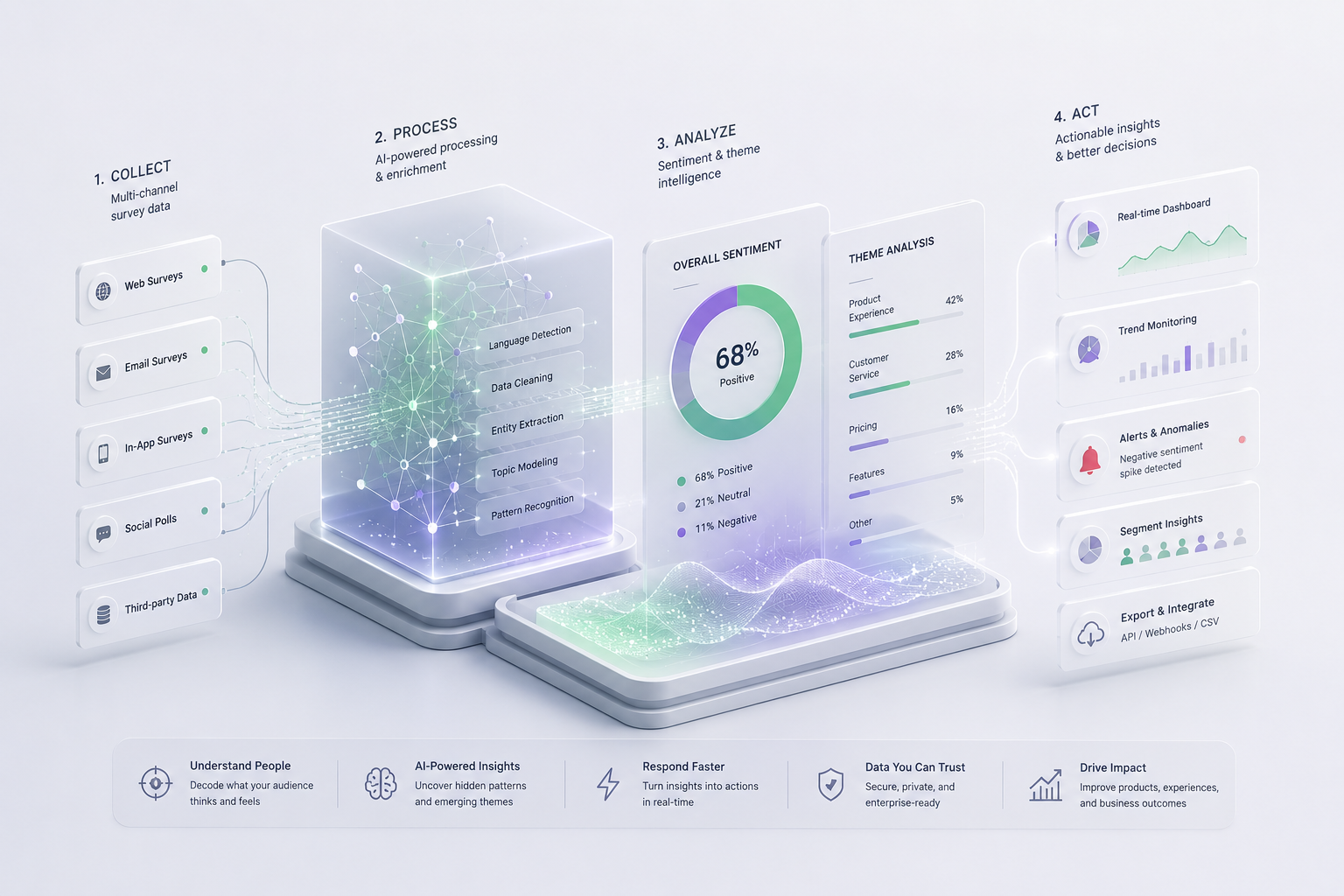
I helped build a Voice-of-Customer intelligence workflow that processes open-text survey comments with an LLM and converts them into structured analytical data.
Each comment is analyzed with relevant survey and journey context.
The system extracts one or more themes from the comment, assigning category, subcategory, and sentiment at the theme level.
The structured outputs are then visualized to show how customer sentiment and themes change across the customer journey.
This allows teams to move from manual comment review to scalable insight generation.
06
How the system works
Collect survey responses
Customer feedback is gathered across multiple journey touchpoints.
Provide context
The system receives the comment along with relevant survey and journey-stage context.
Extract themes
The LLM identifies one or more themes inside the comment.
Classify
Each theme is assigned a main category, subcategory, and sentiment.
Structure
The outputs are converted into analytical tables.
Visualize
Teams can inspect which categories and sentiments trend across different journey stages and customer outcomes.
Act
The insights help identify strengths, friction points, and improvement opportunities.
07
Trust and governance considerations
The key challenge was preserving nuance.
Open-text feedback is messy. Comments can include multiple topics, conflicting sentiment, vague references, and domain-specific language.
Avoiding one-label simplification of multi-topic feedback.
Making categories consistent enough for reporting.
Capturing sentiment at the theme level rather than only the comment level.
Providing enough context so the model understood the customer journey stage.
Designing outputs that analysts and business teams could validate.
Ensuring the system supported decision-making rather than replacing human judgment.
The system was designed to make qualitative feedback analyzable without stripping away the nuance that made it valuable.
08
Impact
The system transformed customer verbatims into a structured intelligence layer.
Faster analysis of open-text survey responses.
Scalable theme and sentiment extraction.
Better visibility of customer pain points across the journey.
Improved understanding of why customers convert or drop off.
Better ability to identify strengths as well as weaknesses.
More evidence-based prioritization of customer experience improvements.
Reduced reliance on manual quarterly or half-yearly review cycles.
The value was not simply classifying comments. The value was helping teams understand what customers were experiencing at each stage of the journey and where operational improvements could influence conversion, satisfaction, and retention.
09
What this project demonstrates
This project demonstrates how AI can make qualitative customer feedback operationally useful.
The organization already had the customer voice.
The system helped turn that voice into structured, decision-ready intelligence.
Next Case Study