Executive Operations
Executive Intelligence System.
AI-powered complaint intelligence for executive operational oversight
01
Overview
Large organizations often collect huge volumes of customer complaints, but the information does not automatically become useful intelligence.
In this case, complaint data already existed inside the organization. It was captured through multiple channels, stored in enterprise systems, and visualized through business intelligence dashboards. But the workflow was not designed for fast executive oversight.
Executives did not need another dashboard to explore manually. They needed a weekly view of what mattered, what changed, what carried risk, and where leadership attention was required.
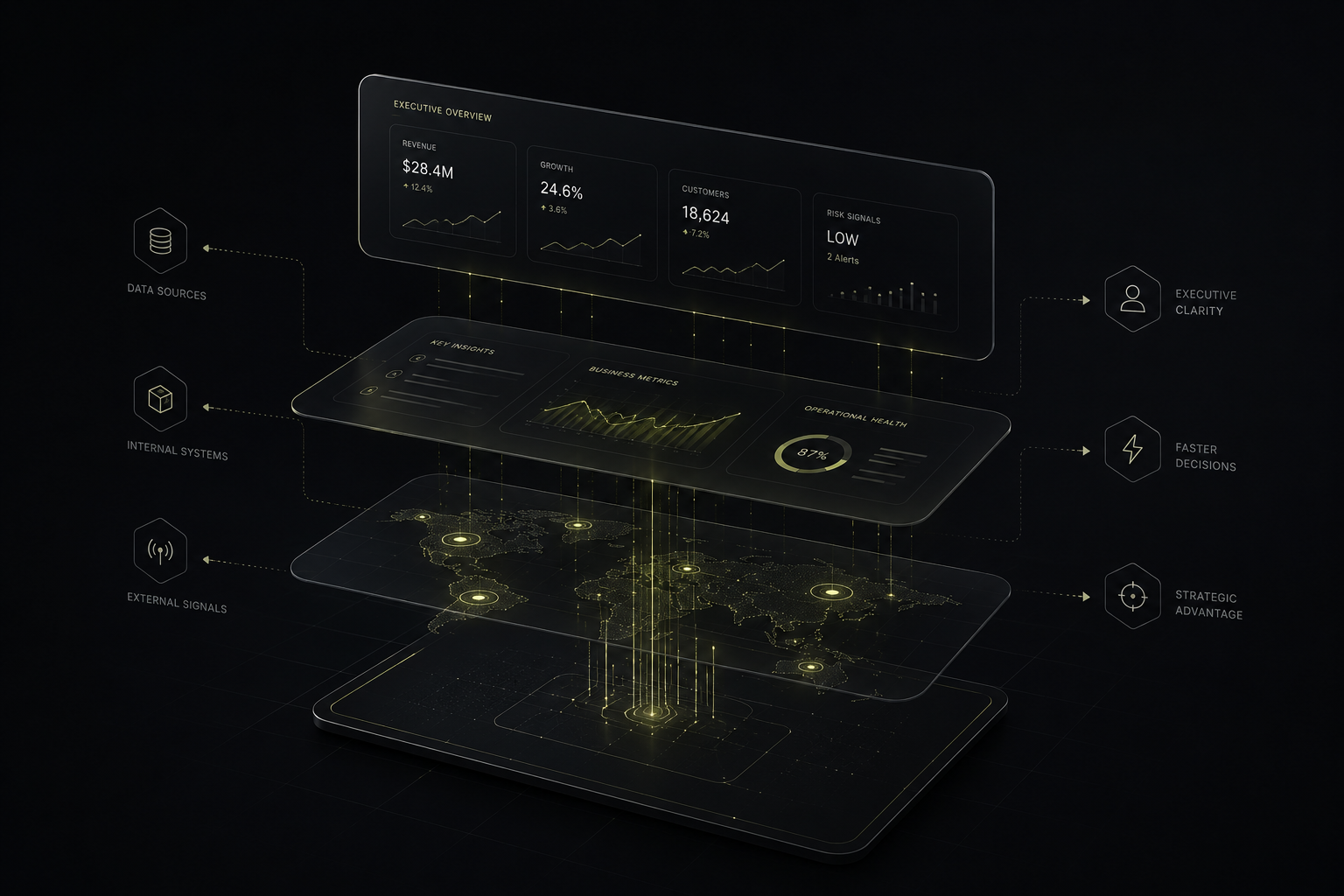
The result was an automated Executive Intelligence System: a production AI workflow that turns raw complaint records into a concise weekly leadership briefing.
02
The operational challenge
The organization already had a formal complaints process and a Power BI reporting layer. Managers and customer service teams could use dashboards to inspect complaint volumes, categories, and service performance.
But the executive workflow was different.
The existing dashboard helped with reporting, but it was not built for fast weekly executive sense-making.
It also relied heavily on broad human-assigned categories from a fixed list. Those categories were useful for reporting, but they often missed the nuance inside the actual complaint text.
For example, a broad category might show that complaints increased in a particular area, but it would not explain that several complaints were specifically about landscaping quality, repeated delays, communication gaps, or a sensitive escalation risk.
The data existed. The insight was buried inside it.
What changed last week?
Which assets or locations are seeing complaint spikes?
Are there sensitive complaints that require executive awareness?
Are any teams falling behind service-level expectations?
Are the underlying complaint themes changing?
How does this period compare with the same time last year?
03
Before
Executives had to rely on static dashboards, broad complaint categories, and manual interpretation to understand what was happening across the business.
Weekly oversight required manual dashboard exploration.
Complaint categories were too broad to explain what customers were actually saying.
Sensitive issues could be hard to separate from routine complaints.
Emerging clusters were not always obvious early.
Year-on-year comparison required additional manual interpretation.
Executives had to spend attention finding the signal instead of acting on it.
04
The AI opportunity
The high-value opportunity was not simply “summarize complaints with AI.”
The real opportunity was to convert raw complaint records into a consistent executive briefing workflow.
The AI system needed to behave less like a generic text summarizer and more like an operational analyst.
Identify meaningful changes from the previous week.
Detect complaint clusters and emerging patterns.
Highlight sensitive complaint types based on business-specific criteria.
Surface assets or locations with unusual complaint movement.
Explain the actual content behind category trends.
Compare current patterns with the same period in the previous year.
Generate commentary that was concise, relevant, and suitable for leadership audiences.
05
The solution
I helped design and implement a scheduled AI reporting workflow that produces a weekly executive email every Monday.
The system connects to complaint records from the enterprise data warehouse, applies structured analysis, and generates a leadership-ready briefing.
Instead of giving executives another dashboard to inspect, the system gives them a curated weekly operational intelligence layer.
A summary of what happened in the previous week.
Sensitive complaints requiring executive awareness.
Assets or locations with unusual complaint activity.
New clusters or major increases in complaint themes.
Service-level risk areas.
Category-level trends.
Year-on-year comparison against the same period.
AI-generated commentary based on the actual complaint content.
06
How the system works
Extract
Complaint records are pulled from the enterprise data warehouse.
Structure
The system groups, filters, and prepares complaint data by time period, asset, category, severity, service status, and comparison window.
Analyze
AI is used to interpret complaint content, detect patterns, explain category movement, and generate business-relevant commentary.
Contextualize
Business rules and contextual information are provided so that the AI can distinguish between routine movement and issues that deserve executive attention.
Govern
Access controls and distribution logic ensure the email is only sent to approved recipients with the right data access.
Deliver
The final briefing is sent automatically to the executive audience on a weekly schedule.
07
Trust and governance considerations
This project required more than prompt engineering.
Because the output was going to executive stakeholders, consistency and governance mattered.
Making sure commentary was repeatable and structured week to week.
Preventing the AI from over-emphasizing low-value noise.
Giving the AI enough business context to generate relevant alerts.
Ensuring sensitive complaint logic was aligned with the organization’s risk criteria.
Limiting distribution to people with the appropriate access.
Designing the report so it was useful without requiring users to understand the underlying dashboard.
The hard part was not only generating a summary. The hard part was deciding what was worth summarizing.
08
Impact
The system shifted executive complaint oversight from manual dashboard exploration to proactive operational intelligence.
Faster weekly visibility for leadership.
Reduced manual effort required to interpret complaint movement.
Better understanding of what customers were actually complaining about.
Earlier identification of sensitive or emerging issues.
More consistent weekly reporting.
Improved ability to connect complaint volume with complaint content.
Better executive awareness of service-level risk.
The value was not that AI wrote an email. The value was that executives received a focused, consistent, business-aware view of complaint risk and customer experience every week.
09
What this project demonstrates
This project shows how AI can create value when it is embedded into a real operational workflow.
The organization did not need a generic chatbot. It needed a reliable weekly intelligence system that understood complaint data, business context, sensitivity criteria, and executive reporting needs.
The system turned fragmented operational records into decision-ready leadership insight.
Next Case Study